
Edge AI in Defence: It’s Not About the Model
Everyone talks about edge AI as though it’s a deployment problem. Push the model closer to the action, they say. Cut the dependency on fragile communications. Make decisions where speed counts. On the surface, that story makes sense. In practice, it’s almost completely wrong.
I’ve spent enough time in defence programmes to know how this usually plays out. A team gets excited about edge AI. They build something impressive in a lab. They run a demo with polished conditions, good power, stable connectivity, everyone in the right uniform reading from the right playbook. Then they deploy it. Within weeks, it’s either not being used or it’s operating in ways nobody intended because the people in the field have learned to work around its constraints.
The actual problem with edge AI isn’t technical. It’s organisational. It’s about sustaining a system across wildly different environments where normal infrastructure simply doesn’t exist.
The Real Operating Environment
Start with a basic fact that should be obvious but rarely is: defence doesn’t get to choose ideal conditions.
Military operations happen in what we call DDIL conditions, which stands for denied, degraded, intermittent, and limited connectivity. That’s not an edge case. That’s the baseline. When a patrol is four people and a vehicle in rough terrain. When a ship is operating under emissions discipline. When an aircraft is at altitude with burst communications only. That’s the normal environment. Everything else is the exception.
The problem with centralised architectures is that they’re built on assumptions that don’t survive contact with DDIL reality. They assume you can reach back to base for identity verification. They assume patches arrive on schedule. They assume time stays synchronised. They assume policy updates happen when you want them to. They assume telemetry makes it home. In an environment where none of those things are guaranteed, every one of those dependencies becomes a failure point.
But DDIL is broader than just a comms problem. When you can’t reliably communicate, you also can’t coordinate with other units. You can’t refresh your reference data. You can’t export diagnostics. You can’t push security updates. You can’t even verify that the person operating the system still has permission to do so. That’s not a connectivity problem. That’s an operating model problem.
Three Different Edges, Three Different Challenges
This is where most discussions go sideways. When people say “the edge,” they usually picture a patrol vehicle or a forward base. That’s part of the picture. But it misses the fact that military edge systems operate across completely different domains, each with its own physics and constraints.
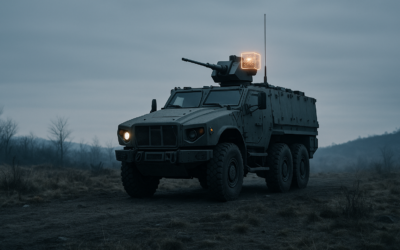
Land is dispersed and constantly moving. A land-based edge system lives on batteries, generators, and whatever solar panels you can fit on a vehicle. The environment is dusty, the personnel rotate frequently, the equipment fails unexpectedly, and the power budget is always exhausted. I’ve watched systems that performed flawlessly in a test facility collapse when they hit a four-person patrol with fifteen minutes of generator runtime and no way to get spare parts for three weeks. The constraints aren’t theoretical. They’re visceral.
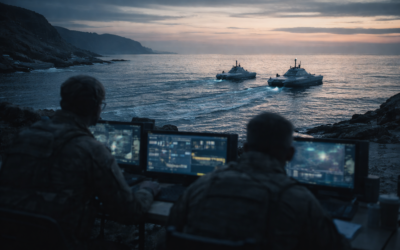
Naval systems have stable power and climate control that land-based operations can only dream of. But the integration story is far more complex. Change windows are rare and planned months in advance. Salt and vibration mean that hardware ages differently. Compartmentalisation limits what you can physically connect and where. Connectivity can vanish or shift based on operational posture and emissions discipline. When you’re designing edge AI for a ship, you’re not thinking about the captain’s display. You’re thinking about whether the system can fuse local sensor data when communications to shore goes down, and whether it can keep functioning safely for days if it has to.
Air platforms face constraints that ground systems barely acknowledge. A system must fit within severe limits on size, weight, power, and thermal capacity. It must meet airworthiness and safety certification requirements that land systems often ignore entirely. Connectivity is intermittent and bursty. And when something goes wrong at altitude, there is no pulling over to diagnose the problem. The system must behave predictably, within known bounds, with an update and rollback story that doesn’t compromise flight safety.
If you design edge AI as a single land-based pattern and assume it works everywhere, you will fail exactly where you need it most and struggle to govern systems where the stakes are highest.
What Actually Determines Success
Here’s what trips up most programmes: they focus on model accuracy when they should be focusing on operating model reliability.
Power is the first reality check. In land environments, you might have fifty watts of continuous power and you need to run everything off a solar panel or a dying generator. In maritime, thermal management is more stable but the equipment corrodes under salt and vibration. In air, you don’t get to choose. You fit within the certified power envelope and that’s it. Across all three domains, the edge stack needs to degrade predictably as conditions worsen, not perform brilliantly until it suddenly doesn’t.
Connectivity assumptions are next. DDIL is not optional. Your system needs to function safely in a state where it cannot reach back to base. Not forever, but long enough to preserve decision-making tempo and prevent catastrophic failure. This isn’t a feature. This is foundational. Any edge proposal that doesn’t have a credible degraded mode is incomplete.
Identity and access models are the third pillar, and this is where I see the most friction in real deployments. When things get intense, when decisions need to happen fast, ambiguous access models produce predictable failure modes. Either operators become paralysed because they’re unsure what they’re allowed to do and afraid of triggering security violations. Or they find workarounds because mission completion always wins over process compliance. Edge AI needs to make the secure path the simple path. Not just in demonstrations. In the actual environment where the system lives.
Then there’s change control and patching. Edge systems deteriorate fast if you skip updates. But they become dangerous if you push updates recklessly. The goal isn’t speed for its own sake. It’s a sustainable rhythm that fits how military operations actually work. Carefully planned change windows. Testing that covers the specific environments where the system operates. Rollback paths that work when something breaks. Governance that people respect because it reflects operational reality, not IT theatre.
Finally, there’s the infrastructure of supportability itself. Hardware fails. Connectors corrode. Drives die. When that happens on a ship or an aircraft, you can’t just order a replacement and install it next week. You need spares that are genuinely available. You need maintenance that’s genuinely repeatable. You need ownership that’s clear. The most credible edge capabilities I’ve seen aren’t the ones with the cleverest models or the most exotic processors. They’re the ones where a junior technician with a manual can diagnose and fix problems under pressure.
Evaluating Proposals That Actually Deserve Trust
If edge AI is fundamentally an operating model problem, then proposals need to be evaluated on that basis, not on demo performance.
A credible proposal can articulate its operating model across all the real constraints. What happens when communications drop for three days? How does identity and policy enforcement work in a degraded state? How are updates actually governed, and what’s the evidence chain when something goes wrong? How is the system supported when it fails at a forward location, far from technical expertise? How does it behave across land, maritime, and air environments?
Success metrics need to change too. Stop measuring average model accuracy. Start measuring operational reality. Can the system maintain decision tempo in degraded conditions? Can it recover cleanly after disruption? Does it stay within acceptable behaviour bounds when operators are under pressure? Is there reliable evidence of what the system actually did?
Most teams skip these questions because they’re harder to answer than “what’s the model accuracy?” But they’re the questions that separate capabilities that work in the real world from capabilities that only work in demonstrations.
The Conversation Forward
Edge AI isn’t a purchase. It’s a capability you need to sustain across fundamentally different environments. Getting inference to run somewhere other than a central facility is relatively straightforward. The hard part is keeping it reliable, governable, and supportable when you can’t rely on the network, can’t rely on the infrastructure, and can’t rely on the environment to cooperate.
What kills edge deployments first in your experience? Is it the assumption that DDIL conditions are temporary rather than baseline? Is it identity and access friction that slows operations? Is it change control that’s too rigid for real operations or too loose for safety? Or is it simpler than that, just not having the spare parts and expertise available when something breaks? And does the answer actually change across land, maritime, and air, or are the core problems the same everywhere?


0 Comments